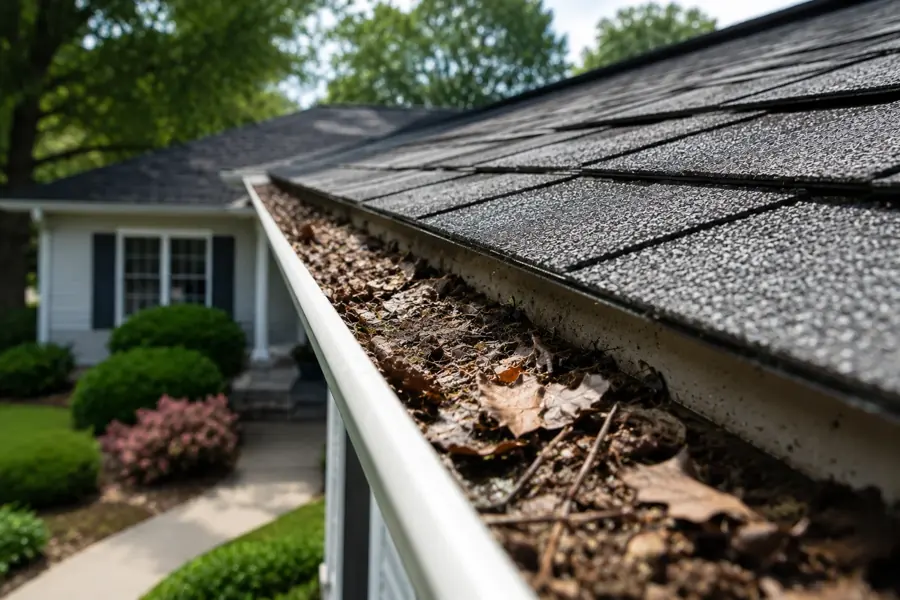
Live oaks are called evergreen, and that is mostly true. They hold their leaves through winter. But each spring, usually late February through April, new leaves push the old ones off, and the tree drops a full year of leaves in a few weeks. At the same time it drops catkins, the stringy yellow-brown tassels that cover cars and driveways all over Mandarin, Riverside, San Marco and Ortega.
That combination is what makes live oak debris so hard on gutters.
Why Live Oak Debris Clogs Worse Than Other Leaves
Live oak leaves are small, stiff and waxy. They do not break down quickly, and they stack flat in the trough. The tassels are the real trouble. They are long and stringy, they tangle together, and when they get wet they form a mat that works like felt. Water runs over it instead of through it.
Add Spanish moss, which falls with every gusty storm, and acorns in the fall, and you get a gutter that can go from clean to blocked in one season. Pine needles from nearby slash pines make it worse because they slide down and bridge across the downspout opening.
Our humidity finishes the job. Debris that would dry out and blow away somewhere else stays damp here, compacts, and by June it has turned into something close to potting soil.
Signs of Clogged Gutters After the Oak Drop
Most people notice the problem the first time a heavy storm hits in May or June. These are the signs to look for before that happens:
- Tassels and leaves visible sticking up over the gutter edge from the ground
- Water pouring over one corner of the house while the rest of the gutter looks fine
- A downspout that only drips during a hard rain
- Dark streaks running down the outside face of the gutter
- Small green sprouts along the gutter line, a sign seeds are rooting in the debris
Gutters Overflowing in Light Rain? Check the Downspout First
If your gutters are overflowing even in a light shower, the trough is usually not the main problem. The downspout is. Everything in the gutter washes toward a hole a few inches across, and the first elbow below it is where tassels and needles jam. From the ground, the trough can look half empty while the outlet is fully blocked.
The test is simple: after clearing the outlet, run a hose into the top of the downspout and watch the bottom. A clear line gives you a strong, steady stream within seconds. A weak trickle, or water backing up at the top, means the elbow still has a plug in it.
Gutter Cleaning Tips for Live Oak Season
- Wait until the drop is done. Cleaning in early March means doing it again in April. Late April or early May is the right time.
- Clear wet debris by hand. Blowing wet oak debris sprays mud and tassels across the siding and windows.
- Do the outlets first. Clearing the downspout opening before the trough lets water carry the rest along as you work.
- Test with a hose. Run water into each downspout from the top and watch the bottom.
- Look at the hangers. A season of wet oak debris is heavy. Loose hangers are easy to fix now and expensive after a run pulls off the fascia.
Should You Trim the Oak or Install Guards?
Trimming branches back from the roof helps, and an arborist can do it without hurting the tree. Many Jacksonville neighborhoods have rules about live oaks, so check with the city before cutting anything large.
Guards help with bulk leaves but not with tassels and pollen, which thread through mesh and mat on top. We go through the real numbers in are gutter guards worth it in Jacksonville. For most oak-covered homes, a scheduled cleaning after the spring drop is the simplest fix.