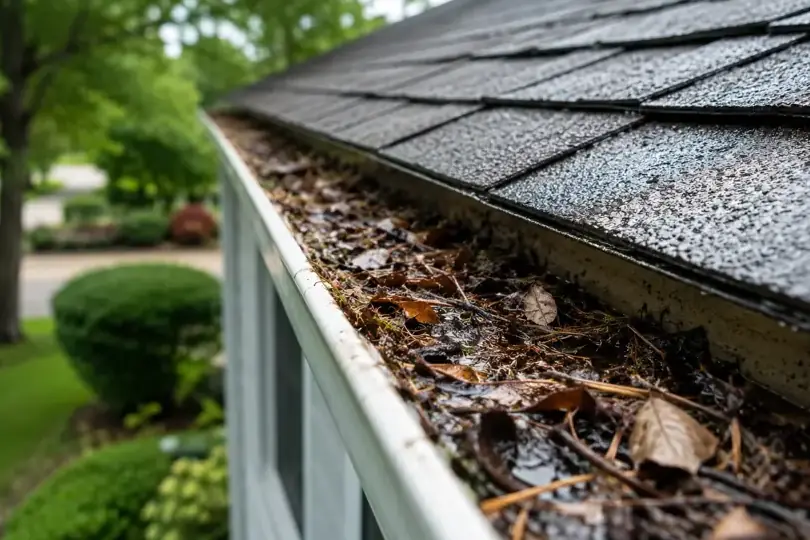
Most Jacksonville yards have both. Live oaks and laurel oaks line the older streets in Riverside, San Marco and Mandarin, while slash and longleaf pines stand over newer lots on the Westside and out toward Oakleaf. The two trees fail a gutter in different ways and at different times of year, which is why a cleaning schedule that suits one can fall short for the other.
How Oak Leaves Clog Roof Gutters
Oak leaves clog by volume and by matting. A live oak drops a full year of leaves in a few weeks between late February and April, along with its stringy catkins. Laurel oaks shed more gradually through late winter. Either way the leaves land flat, stack in the trough, and once they are wet they mat into a layer that water runs across instead of through.
Oak debris is heavy, too. A trough packed with wet leaves holds water like a sponge, and that weight is what pulls hangers out of older fascia. The spring drop has its own write-up in live oak gutter clogs in Jacksonville.
How Pine Needles Clog a Gutter Outlet
Pine needles do not fill a gutter the way leaves do. They slide. Water carries them along the trough until they reach the downspout, and there they turn sideways and bridge across the opening. A few dozen needles across the gutter outlet work like a sieve. The next leaves stick to them, and within a storm or two the outlet is sealed while the rest of the trough still looks nearly empty.
Length matters. Longleaf pine needles can reach 14 inches, loblolly needles run 5 to 6 inches, and sand pine needles only 2 to 3. Long needles bridge the outlet; short ones slip through and pack into the first elbow of the downspout. Florida pines hold their needles for about a year and a half to two and a half years and shed the oldest ones mostly in fall, though a dry spell can bring a heavy drop in spring or summer.
Pine Needles vs Oak Leaves at a Glance
| Oak leaves | Pine needles | |
|---|---|---|
| When they fall in Jacksonville | Late winter through April, with the live oak drop and tassels in spring | Mostly fall, plus smaller drops after drought or storms |
| Where they clog | The trough, in flat wet mats | The gutter outlet and the first downspout elbow |
| What you see from the ground | Leaves sticking up over the gutter edge | Usually nothing, until water spills at one corner |
| How fast they break down | Slowly; live oak leaves are waxy | Very slowly; needles stay springy for months |
| What helps most | A cleaning right after the spring drop | Clearing outlets in late fall and after storms |
Does a Gutter Strainer Help With Pine Needles or Oak Leaves?
A gutter strainer is a wire basket that sits in the gutter outlet to keep debris out of the downspout. It is cheap and easy to put in, and under some trees it helps. It also causes a good share of the overflow we see.
Under oaks, a strainer stops leaves from going down the downspout, which is worth something if the downspout feeds a buried drain line that is hard to clear. The trade-off is that the leaves pile on the basket instead. One heavy rain and the strainer is buried under a mat, and the water goes over the front of the gutter.
Under pines, a strainer is often worse than nothing. Needles thread through the wire and weave into a net that holds everything else, and the basket ends up blocking the outlet it was supposed to protect.
- Keep a strainer if the downspout feeds an underground drain and you will check it after every big leaf drop
- Pull it if the gutter overflows at that corner while the trough looks clear
- Do not treat it as a substitute for cleaning; it only moves the clog up a few inches
Full-length gutter guards are a different product with their own trade-offs. We run the numbers in are gutter guards worth it in Jacksonville.
Roof Gutters Under Both Trees: Why the Mix Is Worst
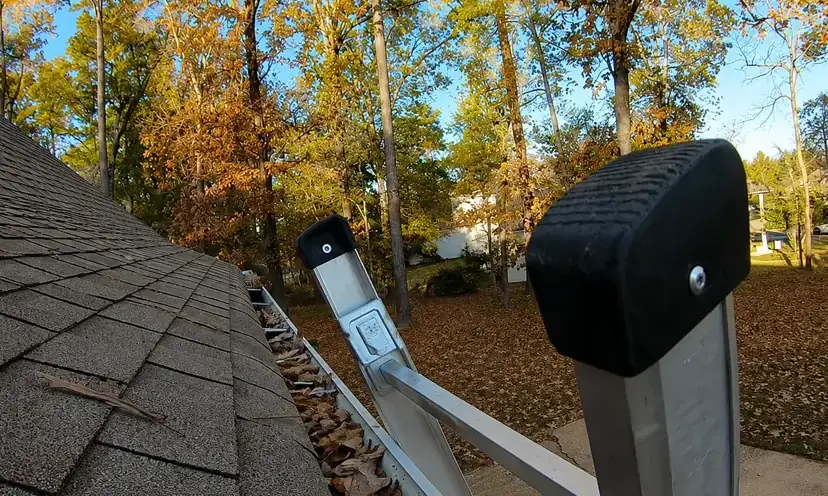
The hardest gutters we clean in Jacksonville sit under an oak and a pine together. Needles lay a framework across the outlet in fall. Oak leaves land on top of it in spring. By May the downspout opening is sealed under a felted plug that a hose alone will not move.
Roof valleys make it worse. Needles collect in the valley where two roof planes meet, then wash down in one load during the first big storm and land in the gutter right where the valley drains, often a few feet from a downspout. If you only have time to check one spot, check the gutter outlet below a valley.
A Cleaning Schedule for Pine, Oak or Both
| Trees over the roof | When to clean | Extra checks |
|---|---|---|
| Mostly oaks | Late April or May, after the spring drop | A quick look before hurricane season |
| Mostly pines | November or December, after the fall drop | Outlets after big storms |
| Both | After the spring drop and again in late fall | Outlets and valleys after every named storm |
| Neither, but palms nearby | Once a year | Frond pieces and seed stalks at the outlets |
For the general rule on frequency, see how often to clean gutters in Jacksonville. Pine-heavy neighborhoods such as Oakleaf and Argyle Forest usually land in the "both" row.
Can I Clear a Pine Needle Clog at the Gutter Outlet Myself?
On a single-story house with good footing, often yes. Scoop the needles out of the outlet by hand first, then reach into the top of the downspout and pull out what you can. Run a garden hose down from the top. A strong, steady stream at the bottom means the line is clear.
If water backs up instead, the plug is in the elbow, and pushing harder with the hose usually packs it tighter. That is the point to take the elbow off or call a crew. Our downspout cleaning page covers how we clear the stubborn ones.